
Review: A journey through the rich tradition of Spanish music
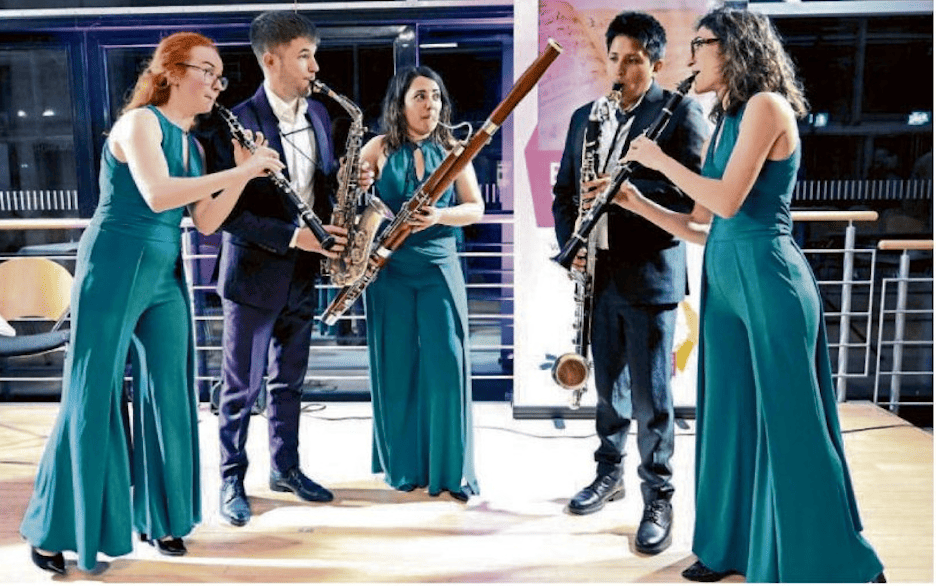
Heide. As part of the Brahms Weeks organized by the Brahms Society of Schleswig-Holstein, Dianto Reed Quintet captivated the audience on Thursday evening with an infectious stage presence, performing under the motto “Dances” in the foyer of the West Coast University of Applied Sciences (Fachhochschule Westküste).
The young Spanish ensemble, based in Amsterdam, consists of five outstanding woodwind musicians who impressively demonstrated the surprising tonal colors and expressive diversity possible with this unusual instrumentation. The evening opened with a specially arranged adaptation of Johannes Brahms’ Waltzes Op. 39—a subtle and refined tribute to the namesake of the Brahms Weeks, reinterpreted with lightness and sonic charm.
With Isaac Albéniz’s Suite Española Op. 47 and Manuel de Falla’s La vida breve, the quintet took the audience on a passionate journey through Spain’s rich musical tradition. Vivid in color, rhythmically pulsating, and performed with infectious enthusiasm, María González Bullón (oboe), Ovidi Martí Garasa (saxophone), María Losada Burgo (bassoon), Erik Steven Rojas Toapanta (bass clarinet), and María Luisa Olmos Ros (clarinet) breathed new life into these classical repertoire staples.
After the intermission, the program took on a more personal note: with Three Preludes to El Amor Brujo, a work dedicated to the ensemble by their fellow student Primo Ish-Hurwitz, the musicians presented a contemporary engagement with de Falla’s famous ballet of the same name. The audience was treated to the lush sound of the bass clarinet, whose deep, growling register was masterfully brought to life by Erik Rojas. The instrument blended seamlessly with the bassoon and other winds, producing rich overtones reminiscent of an organ’s timbre. The arrangement brilliantly highlighted this blend of colors, and the quintet executed it with flawless precision, demonstrating impeccable sound production.
The evening concluded with a traditional Catalan song, touching in its simple beauty, along with several refined wind arrangements of Spanish compositions. The final piece, a dramatic arrangement of Manuel de Falla’s El Amor Brujo by Hugo Bouma, served as a perfect conclusion. Here, the musicians once again reached their peak: gripping, dance-like, and mysterious—a powerful finale that earned a standing ovation from the audience.
Frank-Peter Schulz, Antje Heinrichs, and Birgit Malskat expressed their admiration for the ensemble’s exceptional interplay. They also praised the atmosphere and the surprisingly good acoustics of the venue. Gabi and Martin Thiessen from Welmbüttel, along with Mone Marktscheffel and Michael Pankow from Burg, were equally impressed by the “unusual tones” and the “special venue.” Christiane Hollmann, Gabriele Biehl, and Gudrun Möller from Büsum commended the ensemble’s youthful vigor, remarking: “This is something truly different from what we hear at the Brahms House.”
For them, the ensemble and concert location formed a perfect match. The only regret: “Young people were missing in the audience—they are truly missing out.” Heike Eickhoff-Jasper from Heide was fascinated by the light, almost weightless playing: “As natural as playing a triangle!” Her companion, Yusuf Fidan, added: “Incredible how intensely the musicians interact in dialogue.”
It is no surprise that this quintet, with its unique approach, is gaining international recognition. The ensemble has already received numerous awards—and with this performance, they can now count Heide among their conquered concert venues. The Brahms Society, hosting an event at the West Coast University of Applied Sciences for the third time, once again demonstrated outstanding discernment in selecting the program, ensemble, and venue. For those who missed the performance, another opportunity awaits: the quintet will perform on July 13th as part of the Schleswig-Holstein Music Festival at the “Music Festival in the Countryside” at Gut Stocksee. A date not to be missed by fans of exceptional chamber music—this ensemble is undoubtedly on a rising path to the top.
Article by Andreas Guballa – DLZ (German)